So I am living without fats, without meat, without fish, but am feeling quite well this way. It always seems to me that man was not born to be a carnivore."(Albert Einstein) August 3, 1953
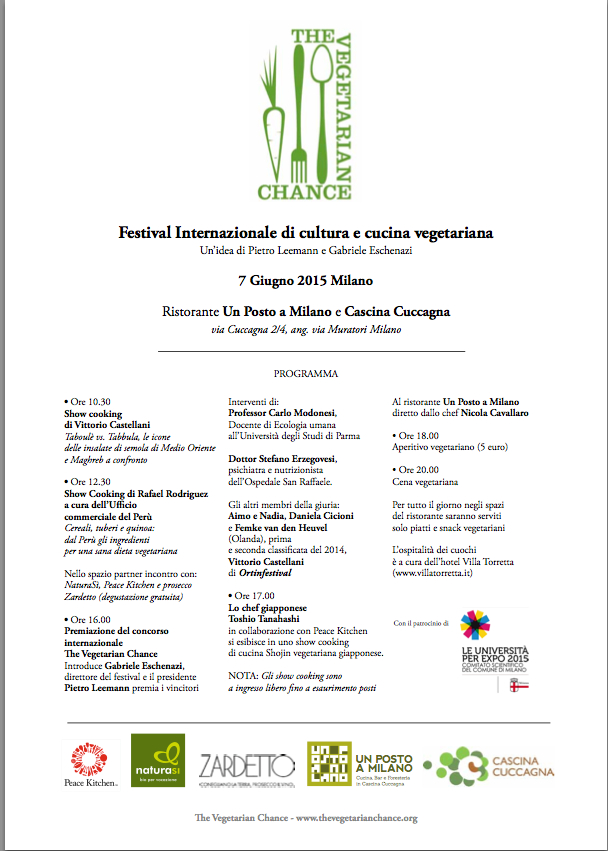
Ecco il programma della seconda edizione del festival The Vegetarian Chance, che si svolgerà domenica 7 giugno a Milano alla Cascina Cuccagna. Here is the program of The Vegetarian Chance festival, second edition, that will be held in Milan at Cascina Cuccagna, via Cuccagna 2/4 (M3 Lodi).
International Festival of vegetarian culture and cuisine by Pietro Leemann and Gabriel Eschenazi
June 7, 2015 Un Posto a Milano restaurant and Cascina Cuccagna Cuccagna st. 2/4, corner Via Muratori
• 10.30 Show cooking by Vittorio Castellani Taboulé vs. Tabbula, salads icons of durum wheat of Middle East and Maghreb: a comparison
• 12.30 Show Cooking by Rafael Rodriguez sponsored by the trade of Peru. Cereals, potatoes and quinoa: Peru ingredients for a healthy vegetarian diet In the partners space meeting: NaturaSì, Peace Kitchen and Zardetto Prosecco (free tasting)
• 16.00 pm Award ceremony of the International contest The Vegetarian Chance. Introduces Gabriel Eschenazi, festival director and Pietro Leemann, the presidente, rewards winners
• 17.00 Japanese chef Toshio Tanahashi in cooperation with Peace Kitchen performs a show cooking about Shojin, vegetarian japanese cuisine
NOTE: The cooking shows are on free admission according to availability
In the restaurant Un Posto a Milano directed by chef Nicola Cavallaro
• 18.00 Vegetarian Aperitif (5 euro)
• 20.00 Vegetarian dinner
During the whole day the restaurant will serve exclusively vegetarian food
THE VEGETARIAN CHANCE Second edition
Our work
Now into its second edition, The Vegetarian Chance is doing so in the year of Milan’s Expo, which highlights the quality and quantity of our nutrition. Our vegetarian proposal is therefore very much in theme. Vegetarianism is gaining share among consumers, chefs, agricultural producers and industrial manufactures, a sign that the message is spreading. In Italy about 7 and a half million people declare themselves as vegetarians and according to Eurispes in 2030 they could become 30 million. The vegetable world is the solution to “feeding the planet”. Last March we organized a round table and discussed this specific subject. As a matter of fact, with our cooperation, a school in Milan has decided to hold a contest of vegetarian cuisine among its students. It’s the Istituto Comprensivo Statale Milano Spiga. Pietro Leemann will award the winners on June 4. This year TVC is twinned with Ortinfestival (www.ortinfestival.it), a festival of contemporary vegetable gardens that takes place at the Royal Palace of Venaria (Turin) from May 30 until June 2 with scheduled three TVC cooking shows staring Pietro Leemann, Daniela Cicioni and Jenny Sugar. The contest At the center of this year’s festival is the international competition of haute vegetarian cuisine. The participants are eight: Anders Ramsay (Stockholm – Sweden), Carla Aradelli (Piacenza – Italy), Mauro Anzideo (Yunnan – China), Nadia Morandi (Milan -Italy), Gianfranco Ceccato (Bellinzona – Switzerland), Francesco Paldera (Bari – Italy), Gianluca Casini (Dusseldorf – Germany), Giuseppe Fusco (Borgomanero, Novara – Italy). Each cook will present two dishes, one of which is entirely vegan and another one with dairy products allowed. The jury, with Pietro Leemann as chairman, will consist of Aimo e Nadia (renown Italian chefs), Daniela Cicioni (winner of the last year’s first contest), Femke Van den Heuvel (second prize last year), biologist and professor Carlo Modonesi, nutritionist and psychiatrist Dr. Stephen Erzegovesi and journalist Vittorio Castellani. The competition will take place at the Joia restaurant from 12.30 to 3:00 pm and will be open to the press and food operators that will have previously registered themselves. To note that the award ceremony will take place in Cascina Cuccagna starting 4:00 pm and will be presented by journalist Gabriele Eschenazi who, together with Pietro Leemann, envisioned and created this festival. Carlo Modonesi and Stefano Erzegovesi will talk about the scientific value of a vegetarian diet. The cooking shows The different cuisines of the world are increasingly popular in our country and thanks to them Italians have come to know many versatile products that can be used in a vegetarian cuisine. Three cooking shows (at Cascina Cuccagna) coordinated by Vittorio Castellani will lead the audience on a trip to the Middle East, Peru and Japan. The first one at 10.30 will be conducted by the same Castellani (aka Chef Kumalè) and is called Taboulé vs. Tabbula, a comparison of the icons of the durum salads of Middle East and Maghreb. To lead the second cooking show at 12:30 will be the Peruvian chef Rafael Rodriguez who will deal with tubers, cereals and quinoa, vegetarian treasures of Peru. Last show at 5:00 pm will exhibit Japanese vegetarian chef Toshio Tanahashi, master of Shojin (vegetarian Japanese cuisine) in association with Peace Kitchen. Vegetarian appetizer Starting at 6:00 pm a vegetarian appetizer will be available for tasting (cost € 5), prepared by chef Nicola Cavallaro in his restaurant Un Posto a Milano within the Cascina Cuccagna.
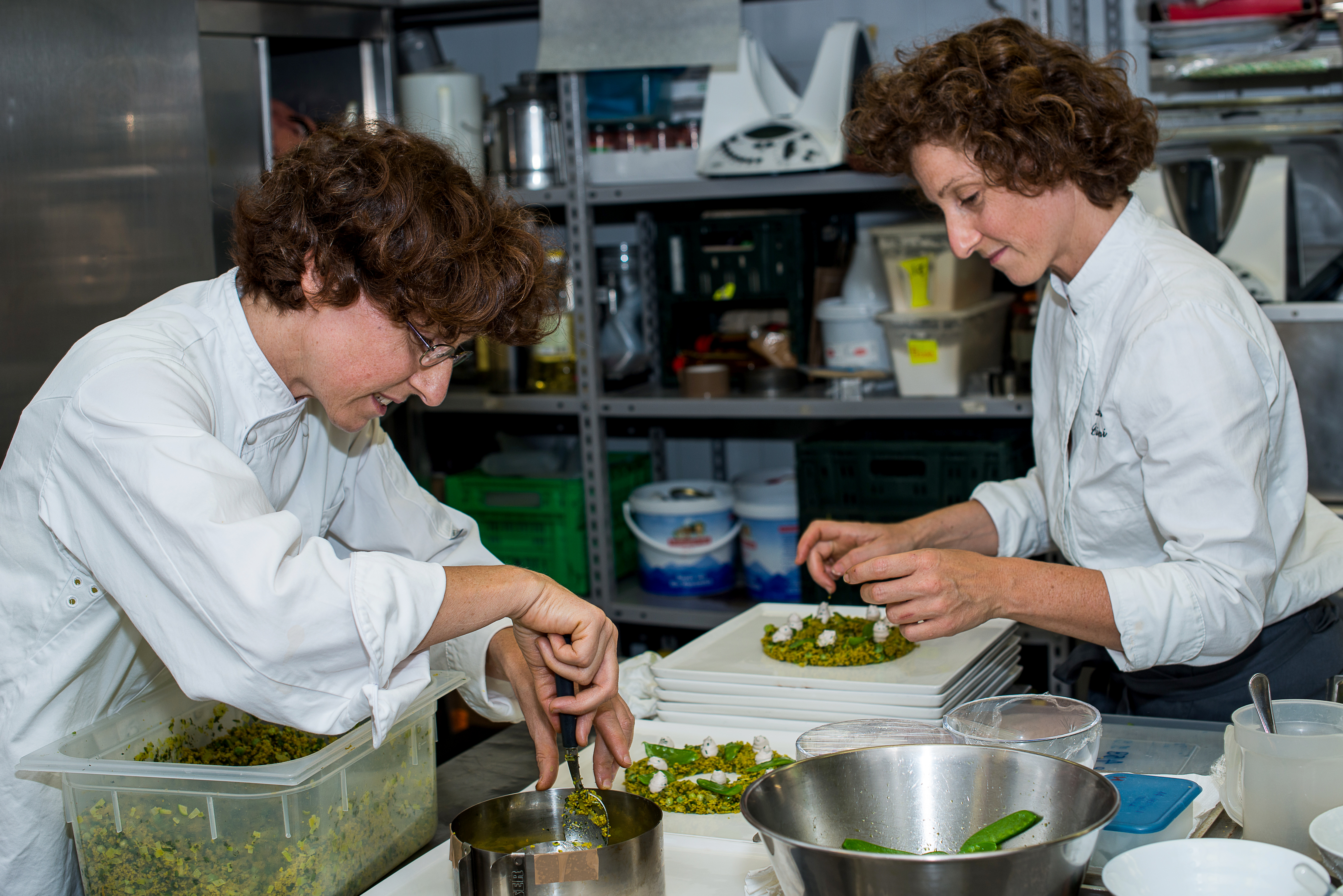
Le gemelle Manuela e Daniela Cicioni al lavoro nella cucina del Joia. Foto di Giovanni Panrotto
Mangiare vegetariano migliora le relazioni tra le persone, sostiene da tempo Pietro Leemann. E chi ha avuto la fortuna di partecipare alla prima edizione del concorso The Vegetarian Chancene ha avuto una prova. Il 22 giugno al Joia cuochi, giornalisti e ospiti hanno interagito con entusiasmo e partecipazione di fronte al colorato scorrere dei piatti proposti dagli otto partecipanti alla competizione vegetariana: Carla Aradelli, Daniela Cicioni, Mario Gagliardi, Femke van den Heuvel, Antonia Klugmann, Alberto Quadrio, Anders Ramsay, Matteo Rizzo. A tutti era stato chiesto di presentare due piatti: un antipasto e un piatto principale.
La giuria presieduta da Pietro Leemann e impreziosita dalla presenza del primo chef italiano, Gualtiero Marchesi, ha assegnato il primo premio a Daniela Cicioni, che è riuscita a conquistare il massimo dei voti con piatti non solo vegani, ma anche crudisti e senza glutine. Il suo antipasto è stato: fermentino fresco e stagionato, pane di farina integrale di mandorle essiccato a bassa temperatura, verdure fermentate in salamoia. Il piatto principale: cous cous di mais con cagliata di mandorle affumicata, fiori di zucchina essiccata, ortaggi. Quest’ultima proposta ha colpito giudici e pubblico per la presentazione estetica artistica e suggestiva. Alle spalle di Daniela Cicioni si è piazzata l’olandese Femke van den Heuvel, che nei suoi piatti ha usato funghi shitake e alghe prodotti in Olanda. Ha saputo dolcificare e salare i suoi piatti senza aggiungere sale o zucchero e questo grazie a un’abilità non comune nel dosare e combinare sapori. Il suo antipasto è stato: lava di verdure primaverili, erbe fresche e verdure di mare. Il piatto principale: tempeh artigianale affumicato fatto con piselli verdi olandesi e fagioli selvatici, con shitake fritto, un cracker di alga, farro germogliato e schiuma di finocchio. Al terzo posto, distanziata di una manciata di punti, si è piazzata Antonia Klugman. A lei la giuria ha attribuito la menzione speciale: Cucina vegetariana del futuro. Il suo antipasto è stato: spinacino selvatico, piantaggine, rose e carcadè. Il piatto principale: il fiore della zucchina affumicato e la nostra senape. In entrambi i piatti si potevano avvertire sapori intensi, ma equilibrati così da non coprirsi a vicenda. Nei piatti ogni ingrediente aveva conservato perfettamente il suo aspetto naturale pur essendo stato cucinato e arricchito di sapori.
Stimolanti e originali anche i piatti di tutti gli altri cinque concorrenti, che si sono impegnati con serietà e creatività nel creare piatti che seguissero i rigidi canoni del concorso.
Carla Aradelli Antipasto: “bortolina” di ceci con zucchine fiorite ripiene di melanzane cotte al naturale e tofu. Piatto principale: pisarei di pane al farro con pomodorini, capperi, semi di zucca e timo alle creme di legumi
Mario Gagliardi Antipasto: dolce, salato, aspro e amaro Piemonte Piatto principale: ying e yang riso e fagioli.
Alberto Quadrio Antipasto: l’asparago bianco Piatto principale: terra (un insieme di legumi, patate, frutta secca e fiori eduli).
Anders Ramsay Antipasto: insalata di asparago&pomodoro. Piatto principale: insalata estiva, involtino di carota e arancia ripieno di spinaci, grano saraceno e un tri di fagioli.
Matteo Rizzo Antipasto: crema di patate con porro caramellato allo zafferano e sapore di mare Piatto principale: funghi porcini al timo in salsa di physalis ed insalatina di pesche
Il commento di Pietro Leemann «Il concorso è stato di altissimo livello. I cuochi hanno ben recepito il tema essenziale del concorso che era quello di proporre una cucina equilibrata, ecologica e salutare. C’è stato persino chi si è spinto più in là proponendo, come Daniela Cicioni, piatti crudisti e senza glutine. Abbiamo avvertito come in tutti i concorrenti c’è stata molta passione nell’elaborare le ricette. Importante è stato lo scambio culturale tra i cuochi. E io stesso ho appreso dai partecipanti idee e spunti come nel caso dei fermentati di Daniela Cicioni e Femke van den Heuvel. Con i loro piatti i cuochi hanno confermato che in Europa verso il mondo vegetariano c’è una sensibilità in crescita. Questo grande successo è un’ottima premessa per la seconda edizione del prossimo anno e alla quale contiamo di far partecipare anche cuochi di altri paesi come Svizzera, Francia, Spagna, Germania, Austria. Il confronto tra paesi diversi è importante per conoscere i diversi approcci alla cucina vegetariana sia nelle tecniche che nel rapporto col territorio».
La competizione è stata arricchita in apertura da due interventi in tema di Cinzia Scaffidi, direttrice del Centro Studi di Slow Food e Joris Heijnen direttore di Variatie in de Keuken (variazioni in cucina), fondazione che promuove in Olanda una cucina sana e sostenibile.
Cinzia Scaffidi ha parlato di sostenibilità ricordando che: «La sostenibilità non deve essere pensata solo per gli esseri umani, ma per tutti gli esseri viventi. La sostenibilità o c’è per tutti o non c’è per nessuno. Il tema dell’Expo Nutrire il pianeta deve significare nutrire davvero tutto il pianeta in tutti i suoi componenti e non solo gli esseri umani. Solo così salveremo la Terra». Sulla scelta vegetariana la direttrice del centro studi Slow Food ha sottolineato: «Compiere oggi una scelta vegetariana o orientata verso una scelta vegetariana significa tornare a ragionare su quello che il nostro corpo ha bisogno. Significa prendere coscienza che il nostro organismo non è programmato per alimentarci con cibo di bassa qualità. Il cibo di bassa qualità non è pensato per alimentare nessuno, ma solo per fare business. C’è la cucina del business e quella dell’alimentazione, che si occupa di nutrire le persone. Dobbiamo scegliere la seconda facendo gesti quotidiani che tengano più conto della nostra salute e degli equilibri del pianeta. Il cibo non è uguale a qualunque altra merce sul mercato. Ha delle implicazioni su salute e ambiente. Per questo abbiamo bisogno di cibo “buono, pulito e giusto” come diciamo da sempre a Slow Food».
Joris Heijnen, che da tre anni si occupa in Olanda di cambiare le abitudini dei suo concittadini in termini di alimentazione ha raccontato la sua esperienza nell’istruire i ristoratori olandesi a proporre cibo vegetariano nei loro locali attraverso corsi specifici e un concorso annuale. Ha ricordato come tra sostenibilità e salute esiste un legame strettissimo e che mangiare del buon cibo sia funzionale a entrambe le cose. Il 18% della Co2 immessa nell’atmosfera sul pianeta deriva dalla produzione di carne. «Il mio obiettivo sin dall’inizio», ha raccontato Joris è stato quello di cambiare gli equilibri nelle portate. Anche chi mangia carne, ne deve mangiare meno e aumentare le verdure nel suo piatto. In Olanda solo il 5% della popolazione mangia verdure a sufficienza”. La competizione vegetariana organizzata da Variatie in de Keuken ha avuto come testimonial Jonnie Boer, cuoco tristellato olandese e si è posta come obiettivo quello di illustrare ai cuochi, amanti della carne quanto versatili siano le verdure in cucina. «In soli tre anni 350 cuochi hanno partecipato ai nostri corsi di cucina vegetariana», ha detto ancora Joris. «Abbiamo anche notato che il livello della competizione sta crescendo ed è diventata a tutti gli effetti un talent show. Tra i partecipanti anche molti giovani ristoratori e piccoli ristoranti delle città che hanno constatato che il vegetarianismo ha un futuro». Oltre al concorso, Variatie in de Keuken ha proposto a diversi ristoranti di misurarsi con la cucina vegetariana lavorando nelle loro stesse cucine con gli ingredienti di una “mystery box” e 72 ore di tempo per elaborare nuove ricette. L’adesione ha toccato il 60% e le foto dei piatti sono finite su Facebook. Un’altra iniziativa è stata quella di organizzare una serata con 50 personaggi olandesi famosi nel campo della musica, del cinema, dello sport, della televisione e della politica. L’obiettivo è stato quello di sensibilizzarli sulla cucina vegetariana e poi chiedere loro di diventare ambasciatori di questa cucina. «Basta che uno di questi personaggi metta la ricetta di un suo succo su twitter che moltissime persone ne assumano l’esempio».
Il commento di Gabriele Eschenazi «Il 22 giugno al Joia abbiamo avuto la conferma che mangiare vegetariano e vegano non è nè triste, nè punitivo, ma è gustoso, interessante, allegro e soprattutto sano per chi cucina e per chi mangia. Abbiamo parlato di cucina vegetariana come di una “chance”, di un’opportunità, e i cuochi del concorso l’hanno colta in pieno proponendo piatti che raramente ci aspettiamo di trovare in un ristorante. Oggi nei menù di piatti vegetariani e vegani accanto piatti di carne se ne trovano sempre di più. La tendenza è ormai quella, sia in Italia che all’estero. Ma ciò che manca è la qualità. Manca il sapere e spesso anche la volontà di proporre al pubblico piatti vegetariani e vegani buoni, appetitosi, interessanti che tengano conto del territorio e delle stagioni. Con The Vegetarian Chance abbiamo inteso sensibilizzare cuochi, ristoranti e consumatori su questo tema. Lo abbiamo fatto quest’anno e lo rifaremo a maggior ragione l’anno prossimo quando a Milano si terrà l’Expo e si dovrà, speriamo, parlare di cibo non solo in termini gastronomici, ma anche in termini di salvaguardia del pianeta. E l’opportunità vegetariana sarà lì per dire la sua».
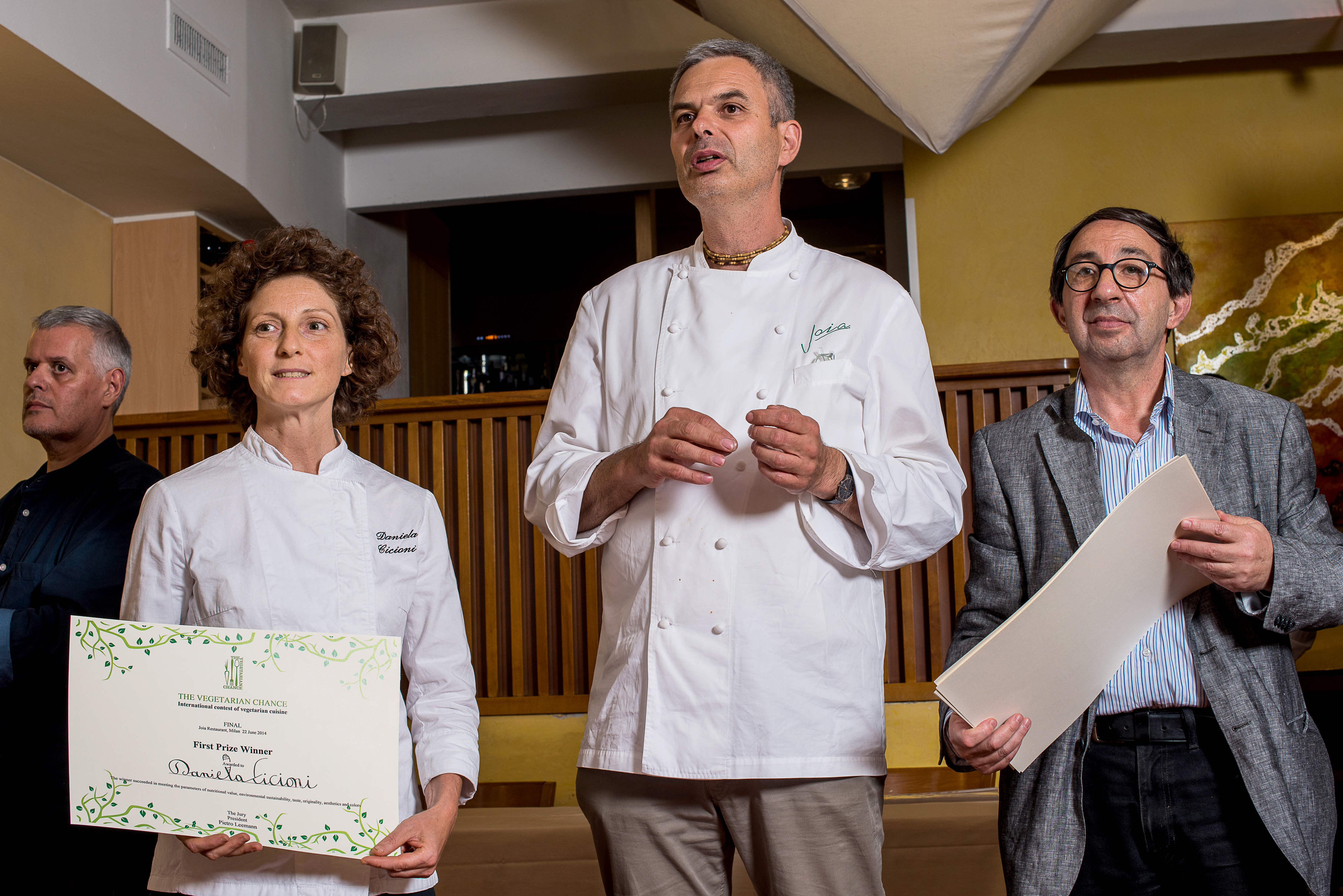
La prima classificata Daniela Cicioni premiata da Pietro Leemann e Gabriele Eschenazi creatori e organizzatori del concorso
GRAZIE!
La “brigata” del ristorante Joia ha preparato con Pietro Leemann la cena di gala al Monte Verità e ha orchestrato perfettamente tutto il concorso nella cucina del Joia. Lo staff del Monte Verità e il direttore Lorenzo Sonognini, con un’organizzazione impeccabile, hanno garantito la riuscita dell’evento del 7 giugno al Monte Verità. Il logo di The Vegetarian Chance è stato creato dalla graphic designer Irene Poma. Le foto ufficiali dei piatti sono state eseguite dal fotografo professionista Giovanni Panarotto. I certificati consegnati a tutti partecipanti al concorso sono stati disegnati da Sophia Besso, mentre i nomi dei cuochi sono stati scritti per l’occasione dal gallerista e artista milanese Jean Blanchaert. Un menzione particolare va al maestro Gualtiero Marchesi, che con la sua presenza ha aggiunto valore alla manifestazione. Si ringrazia il BEST WESTERN Antares Hotel Concorde di Milano per la sua collaborazione all’ospitalità dei partecipanti al concorso. Tutto il Festival è stato seguito e raccontato da Fine Dining Lovers, il magazine online di S.Pellegrino&Acqua Panna partner di The Vegetarian Chance. A tutti un affettuoso ringraziamento per il loro contributo, prestato con passione e professionalità.
Partner: S.Pellegrino & Acqua Panna
THE CONTEST: THE WHOLE STORY
Daniela Cicioni first prize, Femke van den Heuvel second prize The vegetarian contest speaks Italian and Dutch
Eating vegetarian cuisine improves relationships between people: this is a Pietro Leemann’s idea. And the lucky people who attended the first occasion of The Vegetarian Chance had that demonstrated to them. On June 22, at Joia, chefs, journalists and guests interacted with enthusiasm as they participated in the colourful flow of dishes from the eight participants in the vegetarian cuisine competition: Carla Aradelli, Daniela Cicioni, Mario Gagliardi, Femke van den Heuvel, Antonia Klugmann, Alberto Quadrio, Anders Ramsay, Matteo Rizzo. Each was requested to submit two dishes: an appetizer and a main dish.
The jury, chaired by Pietro Leemann and enhanced by the presence of premier Italian chef Gualtiero Marchesi, awarded the first prize to Daniela Cicioni, who achieved the highest marks with dishes that were not only vegan, but also gluten-free and ‘raw foodist’. Her entree was: “fermentino” fresh and seasoned, whole wheat bread with almonds, dried at low temperature and fermented vegetables in brine. The main dish: corn couscous with almonds smoked curd, dried zucchini flowers, vegetables. The latter offering impressed the judges and audience with its artistic aesthetic and evocative presentation.
The runner up to Daniela Cicioni is the Dutch cook Femke van den Heuvel, who used in her dishes shitake mushrooms and seaweed produced in the Netherlands. She was able to sweeten and season the dishes without adding salt or sugar and all this is due an uncommon ability in the dosing and combination of flavors. Her entree was: lava of spring vegetables and fresh herbs with sea vegetables. The main dish: roll of asparagus stuffed with hazelnut ricotta, home made smoked tempeh of Dutch peas with fried shiitake cracker served with earth sandy shitake powder and a risotto of dutch pearl barley.The third place, separated by a few points only, was assigned to Antonia Klugman. The jury awarded her a special mention: Vegetarian cuisine of the future. Her entree was: wild spinach, plantain, roses and carcadè. The main dish: smoked zucchini flower with mustard. In both dishes one could feel intense and balanced flavors at the same time in such a way that they didn’t mask each other. Each ingredient in the dishes was perfectly preserved with its natural appearance, despite being cooked and having enriched flavors.
Stimulating and original dishes were presented too by all the remaining five contestants, who showcased their professionalism and creativity in inventing dishes that followed the strict rules of the competition.
Carla Aradelli
Appetizer: “bortolina” (typical dish from Piacenza) of chickpeas with flowers zucchini stuffed with eggplant and tofu cooked natural.
Main Dish: pisarei of spelt bread with cherry tomatoes, capers, pumpkin seeds and thyme with cream legumes
Mario Gagliardi
Appetizer: sweet, salty, sour and bitter Piemonte
Main Dish: ying and yang rice and beans.
Alberto Quadrio
Appetizer: white stuffed asparagus
Main Dish: Earth (a combination of legumes, potatoes, dried fruit and edible flowers).
Anders Ramsay
Appetizer: A budding sensation… Tomato&asparagus salad
Main course: …And then the flowers! Summer salad, carrot&orange roll filled with spinach,
buckwheat and trio of beans
Matteo Rizzo
Appetizer: mashed potatoes with caramelized leek with saffron and sea taste
Main dish: Porcini mushrooms with thyme and physalis sauce and peaches salad
Comment by Pietro Leemann.
«The level of the contest was very high. The chefs understood very well that the essential aim of the contest was to offer a balanced, eco-friendly and healthy cuisine. There were even those who went further by offering, such as Daniela Cicioni, raw and gluten free food. We felt the passion of the competitors in developing the recipes. The cultural exchange among the chefs was very important. I myself have learned from the participants ideas and suggestions; for example the use of fermented foods by Daniela Cicioni and Femke van den Heuvel. With their dishes the chefs have confirmed that in Europe and in the world there exists an increasing sensitivity to vegetarianism. This great success is a perfect premise for the second occasion of festival next year, when we hope to involve cooks from many other countries such as Switzerland, France, Spain, Germany and Austria. The comparison between different countries is important in order to develop a knowledge of the different approaches to vegetarian cooking from the perspectives of techniques and the relationship with the land».
The contest was enriched at the opening by speeches from Cinzia Scaffidi, Director Slow Food Studies Center and of Joris Heijnen Director of Variatie in de Keuken, a Dutch foundation that promotes healthy and sustainable food.
Cinzia Scaffidi talked about sustainability saying: «Sustainability should not be thought of as only for humans, but for all living beings. Sustainability exists for everybody or doesn’t exist at all. The subject of the Expo “Feeding the planet” should mean really feeding the whole planet in all its components, and not just human beings. Only by this way will we save the Earth». Speaking on the vegetarian choice the director of Slow Food research center has pointed out: «Making a choice today oriented towards a complete or partial vegetarian diet means going back to think more of our body’s needs. It means becoming aware that our body is not programmed to be fed with low quality food. Low quality food is not meant to feed anyone, but just to make business. There is a cuisine that is made for business and another designed to feeding people. We must choose the latter with everyday acts that take into account our health and the balance of the planet. Food is not to the same as any other goods on the market. It has implications for health and the environment. For this reason we need “good, clean and fair food” as we, Slow Food, always say».
Joris Heijnen, engaged for the last three years in the Netherlands with the mission of changing the food habits of his fellow citizens, told of his experience in teaching Dutch restaurateurs to offer vegetarian food in their places through specific courses and an annual competition. He reminded us how there is a very close link between sustainability and health and how eating good food is a contributes to both. Today, 18% of the CO2 released into the atmosphere of the planet comes from meat production. «My goal from the beginning,» said Joris «was to change the balance in the dishes. Even those who eat meat, should eat less meat and increase the proportion of vegetables on their plates. In the Netherlands, only 5% of the population eat enough vegetables».
The competition organized by Vegetarian Variatie in de Keuken had as a testimonial Jonnie Boer, the Dutch three starred cook, and has set itself the goal of illustrating to the cooks, meat lovers, how versatile vegetables are in the kitchen. «In just three years, 350 chefs participated in our vegetarian cooking classes,» said Joris. «We also noticed that the competition level is growing and has become in effect a talent show. Among the participants are also many young restaurateurs and small restaurants of cities that have discovered that vegetarianism has a future.» In addition to the competition, Variatie in de Keuken has suggested to several restaurants to compete with vegetarian cuisine in their own kitchens using the ingredients of a “mystery box”, with a limit of 72 hours to create new recipes. The take up on this offer has reached 60% and photos of the new dishes have been published on Facebook. Another initiative has been to organize an evening with fifty Dutch VIPs in the field of music, film, sports, tv and politics. The aim of this was to raise awareness of vegetarian cuisine and ask them to become ambassadors for the cuisine. «If just one of these people, for example, published the recipe of a juice on his twitter account, many people would follow by example.»
Comment by Gabriel Eschenazi
“On June 22, at Joia we had confirmation that eating vegetarian and vegan is neither sad nor punitive, but is tasty, interesting, cheerful and especially healthy for those who cook and those who eat. We talked about vegetarian cooking as a “chance”, and the cooks of the contest took the opportunity by proposing dishes that we rarely expect to find in a restaurant. Today on the menu alongside meat dishes we find more and more vegetarian and vegan dishes. This is now the trend, both in Italy and abroad. But what is missing is quality. There is often a lack of knowledge and the real will to offer the consumers, tasty, attractive vegetarian and vegan dishes, which take into account local and seasonal products. By organizing The Vegetarian Chance we intended to raise the awareness of chefs, restaurants and consumers on this issue. We have done it this year and will do it still more again next year when we’ll host the Expo here in Milan, which, hopefully, will deal with food, not only in gastronomic terms, but also in terms of saving the planet. And The Vegetarian Chance will be there to put its case“.
THANK YOU!
The “brigade” of the restaurant Joia prepared with Pietro Leemann the gala dinner at Monte Verità and perfectly orchestrated all of the contest in the kitchen of Joia restaurant.
The staff of the Monte Verità and its director, Lorenzo Sonognini, with impeccable organization, have ensured the success of the 7th June event at Monte Verità. The logo of The Vegetarian Chance was created by graphic designer Irene Poma. The official photos of the dishes were performed by professional photographer Giovanni Panarotto.
The certificates given to all participants in the contest were designed by Sophia Besso, while the names of the chefs were written for the occasion by the milanese artist and gallerist Jean Blanchaert. A special mention goes to the master of cooks Gualtiero Marchesi, who added value to the event with his presence.
We thank the BEST WESTERN Antares Hotel Concorde Milan for its cooperation in the hospitality of the participants in the contest.
The whole festival was followed and narrated by Fine Dining Lovers, the magazine online of S.Pellegrino & Acqua Panna, media partner of The Vegetarian Chance.
Thanks to alla them for their contribution, given with passion and professionalism.
Mario Gagliardi ristorante Il CascinaleNuovo di Isola d’Asti
Femke van den Heuvel ristorante Vlamindepan Haarlem Olanda
Antonia Klugmann ristorante Venissa Venezia
Alberto Quadrio ristorante Asola-Cucina sartoriale Milano
Anders Ramsay Elwing&Co catering Solna (Stoccolma- Svezia)
Matteo Rizzo ristorante il Desco Verona
Ore 10.30 In cucina i cuochi preparano i piatti vegani in concorso: un antipasto e un piatto principale.
In sala interventi di: Cinzia Scaffidi direttrice del Centro Studi Slow Food,Joris Heijnen direttore di Variatie in de Keuken(variazioni in cucina), fondazione olandese che promuove in Olanda una cucina sana e sostenibile
Ore 12.30 Gli chef finalisti escono insieme ai loro piatti e ne raccontano preparazioni e motivazioni. La giuria assaggia i piatti.
Ore 14.30 Premiazione e light lunch per tutti i partecipanti.
Joris Heijnen direttore olandese di Variatie in de Keuken
Luca Sacchi gastronomo e ricercatore
Lorenzo Sonognini esperto ambientale
Parametri di giudizio della giuria: idea del piatto 10%, estetica nella forma e nell’abbinamento dei colori , 20% gusto, 30% valore alimentare e nutrizionale, 20% sostenibilità ambientale, 20%.
Evento riservato alla stampa, ai cuochi e agli specialisti del settore. Registrazione presso: thevegetarianchance@gmail.com





 The Vegetarian Chance